Swiping toward Dysregulation: How a Decade of Gamifying Intimacy Has Shaped Our Nervous Systems
The way we look for love right now is training our nervous systems away from the very thing we say we want.
We talk constantly about nervous system regulation. We breathe in boxes, we name our triggers, we learn the language of co-regulation. Then we pick up our phones and spend the evening swiping. Dating apps may be the most normalized form of dysregulation we have, so ordinary that we no longer notice what they ask of our bodies. Breathwork and nervous system practitioner Summer Valentino speaks often about nervous system dysregulation and how dating apps feed it. Her lens shapes much of what I explore in this research paper.
We have gamified intimacy. And a game, played long enough, changes the player. This isn't a moral argument about dating apps. People meet partners on dating apps every day, and some of those relationships are beautiful. This is a closer look at what the swipe does to a nervous system over time, what it trains us toward, and how we can choose differently.
The slot machine in your pocket
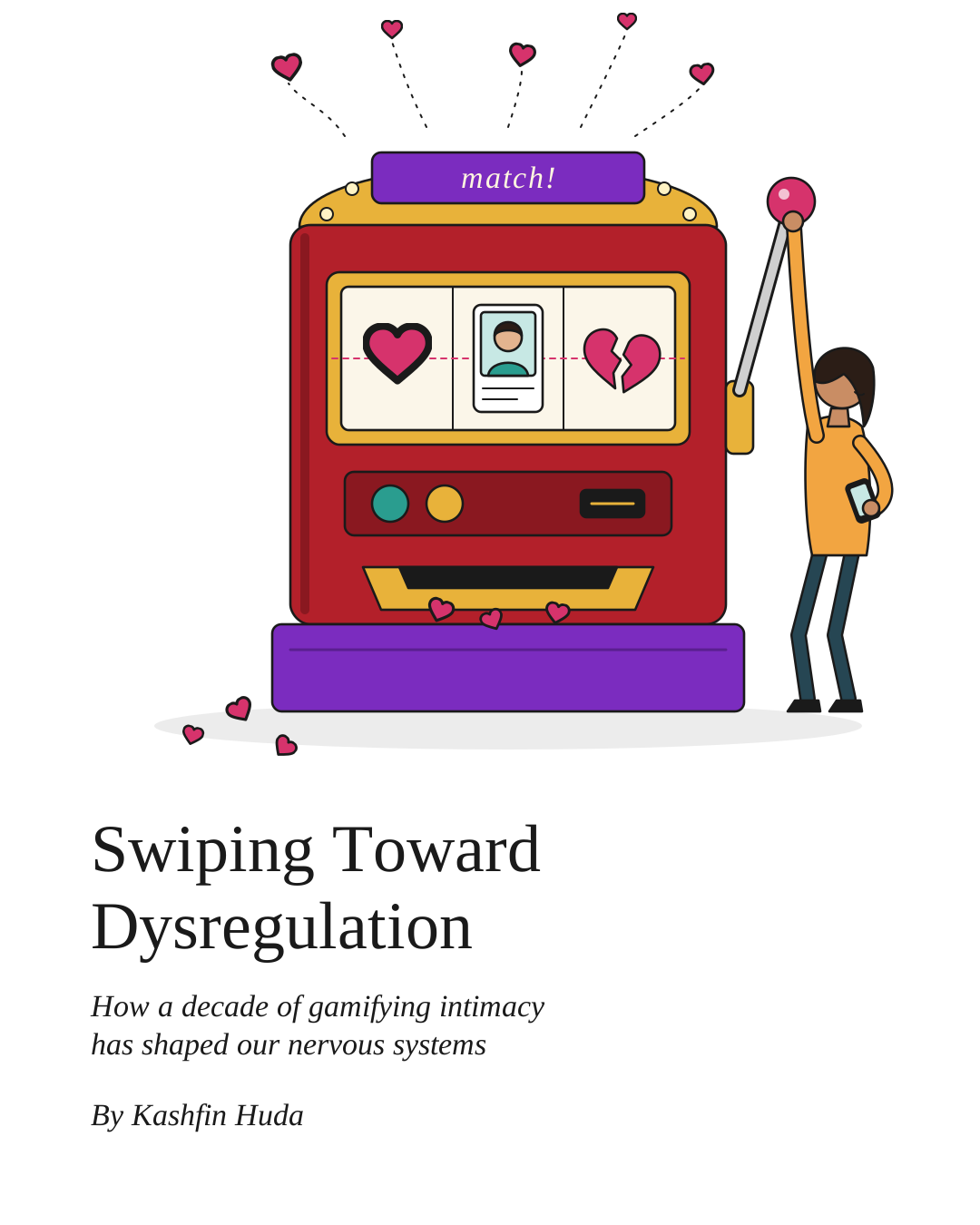
The swipe is built on the same reward logic as a slot machine: unpredictable payoffs keep us pulling the lever. We tend to think of dopamine as the pleasure chemical. It is better understood as the anticipation chemical, the system that orients us toward a reward that might be coming. In a landmark 2003 study in Science, Fiorillo, Tobler and Schultz found that dopamine neurons don't only respond to rewards. A separate signal ramps up while waiting for an uncertain reward, and it peaks when the odds sit near a coin flip.
In other words, the brain is most engaged not when reward is guaranteed, but when it is uncertain. Behavioral psychologists have known a version of this since Skinner: variable reward schedules produce the most persistent, hardest-to-extinguish behavior. Researchers studying gambling make the connection directly. Slot machines, roulette and craps all cluster near the odds that should drive dopamine hardest.
Now look at the swipe. Each card is a small bet. The match is the unpredictable payout. The feed never ends, so there is always one more pull. The system that evolved to help us orient toward a potential mate is being run on a schedule designed for compulsion. That doesn't make every app user an addict. But it does mean the interface is speaking to the oldest, least deliberate part of our motivation, and it is very good at it.
What the swipe trains
The research on dating app use points in one consistent direction: more swiping travels with more anxiety, lower self-worth and a growing habit of rejection.
A few findings stand out:
Rejection becomes a reflex. In a Tinder-style experiment, Pronk and Denissen (2020) found people grew more rejecting with every profile they saw. Acceptance fell by about 27% from the first option to the last. They called it a "rejection mindset": endless choice makes us more pessimistic, and we gradually close off.
Distress rises with use. A 2020 study in BMC Psychology found swipe-app users were about 2.5 times more likely to report psychological distress than non-users. Heavier and longer use tracked with more distress and depression.
Self-worth takes a hit. Strübel and Petrie found Tinder users reported lower body satisfaction than non-users, and male users reported lower self-esteem. Anxious attachment and the apps find each other. Several studies show people higher in attachment anxiety use dating apps more intensely, and are drawn to them partly for reassurance and approval.
Here is the honest part: most of this research is correlational. Anxious, lonely or self-doubting people may be drawn to the apps, as much as the apps make people that way. The truer picture is probably a loop. An anxious nervous system reaches for the swipe;the swipe rewards the reaching; the anxiety gets its practice.
Whatever the starting point, the result is the same. A nervous system gets calibrated to rapid cycling through potential partners, and away from the slower, more demanding work of staying with one.
What real connection actually requires
The kind of connection that actually regulates us needs three things the swipe can't supply: time, presence and being known slowly. Brains sync when we truly understand each other. In a 2010 study, Princeton neuroscientists Stephens, Silbert and Hasson scanned a speaker telling a story and the people listening. The listeners' brain activity coupled with the speaker's. When communication failed, the coupling vanished. And the more a listener's brain anticipated the speaker's, the deeper their understanding. Connection is not only a feeling. It is two nervous systems falling into rhythm.
Bodies regulate each other, and the relationship matters. In James Coan's "Lending a Hand" study (2006), women facing the threat of a mild shock showed much calmer threat responses while holding their husband's hand, and only a small effect with a stranger's hand. The calming was strongest in the happiest marriages. Co-regulation is real, but it is earned through a relationship. A stranger's hand barely works.
Closeness is built in hours. Communication researcher Jeffrey Hall (2018) estimated it takes roughly 50 hours together to move from acquaintance to casual friend, and more than 200 to become close friends. For adults, the numbers ran even higher. You can't snap your fingers and be known.
None of these conditions live inside a feed. Rhythm, touch, accumulated hours: these are the slow ingredients of safety, and safety is what lets intimacy happen at all.
The simulation of possibility
What the app produces is the feeling of possibility without the conditions for connection. The nervous system gets the dopamine hit of potential intimacy, over and over, without ever arriving at the real thing. And because dopamine lives in anticipation, the hit is strongest before anything has been risked. The match feels better than the first date. The first date feels better than the third. Possibility is frictionless. Reality has texture.
This is the shape of so much modern dating pain. Someone pursues hard, then disappears.Someone texts for weeks, then goes quiet the moment plans become real. We call it ghosting, or avoidance, or "not being ready." Underneath, it is often a nervous system doing exactly what it was trained to do: chase the uncertain reward, then flee when the reward asks for something back.
Because the real thing asks a lot. It asks us to tolerate uncertainty without a feed to soothe it. It asks for vulnerability. It asks us to sit in the discomfort of actually being seen, with no next card waiting.
A nervous system trained on the swipe is one that finds slow-building love increasingly hard to tolerate. Not because we are shallow or broken, but because we have practiced the opposite for years.
Choosing consciously
If the swipe is training, then something else can be training too. A nervous system that learned one rhythm can learn another.
Healing might look like:
Fewer options, held longer. Choice overload is part of the problem. Talking to one or two people at a time gives the nervous system a chance to settle instead of scan.
Noticing the pull. The urge to open the app after a vulnerable moment is information. Often it is the body looking for a quick hit of possibility to escape the discomfort of a real one.
Staying a little past the edge. When the instinct to pull away arrives on date three, staying curious one more beat is how tolerance for intimacy grows.
Moving toward presence. Voice, face, shared time and physical space are where coupling and co-regulation actually happen. Text and photos are previews, not the thing.
Measuring in hours, not matches. Real closeness accrues slowly. Judging a connection by its first spark trains us to keep leaving.
Truth be told, this is why I built Eternity (currently in beta). It's a voice-first relationship intelligence app that does away with swiping entirely. You have one in-depth conversation, and you receive one highly curated, vetted match at a time. No feed, no slot machine. Just fewer options, held longer, by design.
We didn't choose the design of the tools we were handed. But we can choose what we practice with them, and whether we put them down.
Love has always asked for patience, presence and the courage to be known. The question isn't whether dating apps are good or bad. It's whether we are letting them teach our nervous systems to want possibility more than we want each other.
Sources:
Fiorillo, Tobler & Schultz (2003), Science: dopamine coding of reward uncertainty
Anselme & Robinson (2013), Frontiers: dopamine's role in gambling
Pronk & Denissen (2020): A Rejection Mind-Set
Holtzhausen et al. (2020), BMC Psychology: swipe apps and mental health
Strübel & Petrie (2016): Tinder use and self-worth
Chin et al. (2019): attachment orientation and dating app motives
Topino, Griffiths & Gori: anxious attachment and problematic app use
Stephens, Silbert & Hasson (2010), PNAS: speaker-listener neural coupling
Coan, Schaefer & Davidson (2006), Psychological Science: Lending a Hand
Hall (2018): How many hours does it take to make a friend?
Notes on the research
The science supports the argument's direction, but most dating-app findings are correlational.*